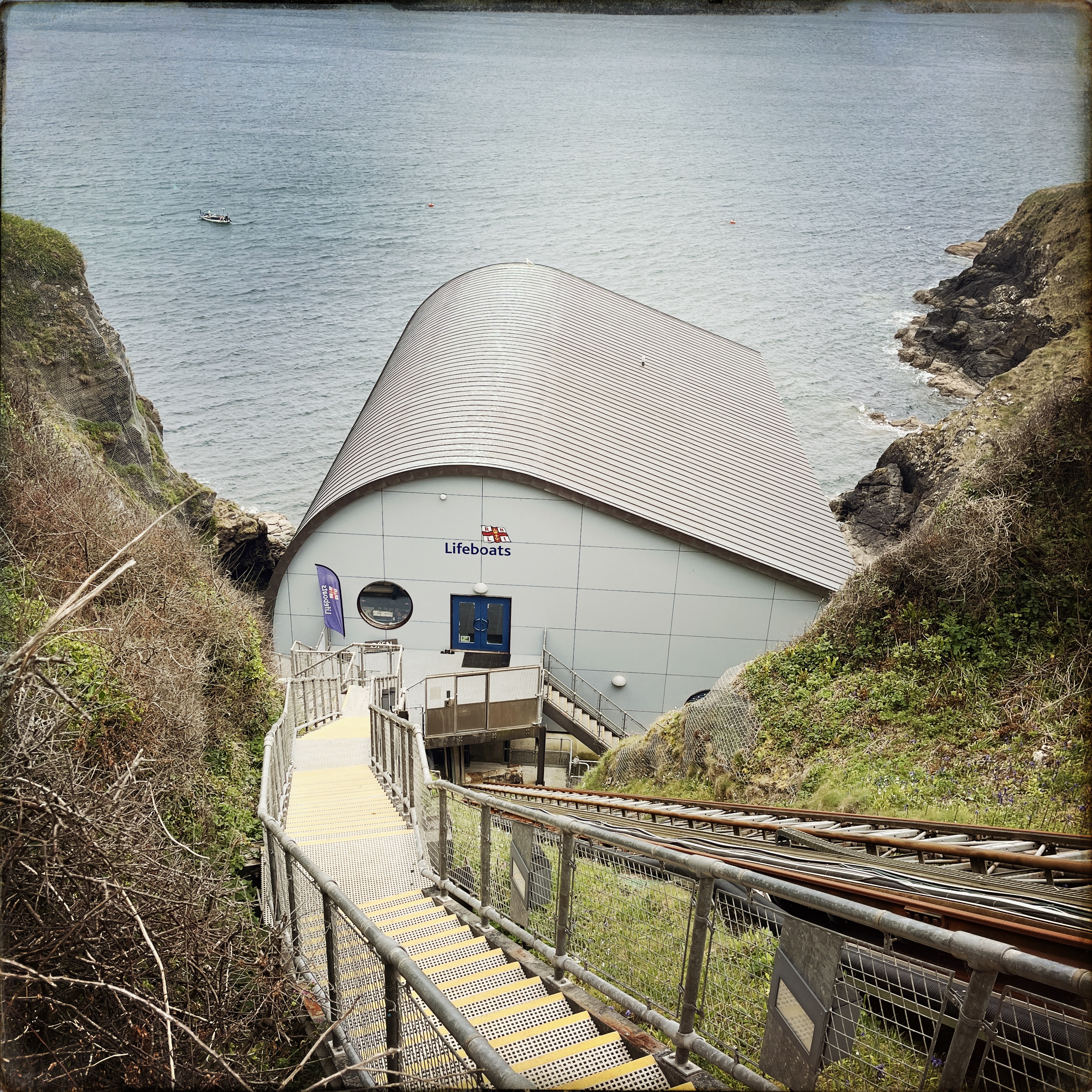
At the beginning of May, my lovely husband and I had the great pleasure of visiting the Lizard Lifeboat Station in Southern Cornwall to drop off a copy of Sienna Fitch. As it was under construction the last time I was there, I was thrilled to finally experience one of the UK’s most remarkable maritime buildings. Like, small-child giddy. Ask my lovely husband.
Nestled into the dramatic cliffs of Kilcobben Cove in Southern Cornwall, the station is a marvel of modern engineering, built at the base of a near-vertical, 45-metre precipice. Entirely inaccessible by normal construction vehicles, every single beam and girder was craned in from giant sea barges or lowered down the rock face via a bespoke funicular railway.
To challenge the architects even further, the site sits on both a Site of Special Scientific Interest (SSSI) and within the Cornwall National Landscape (formerly known as an Area of Outstanding Natural Beauty, or AONB). The design respects this through its natural Cornish slate roof and granite-and-timber walls, both of which weather beautifully in the salt air, allowing the station to melt seamlessly back into the cliffs.
Curved glue-laminated timber arches frame the vast space inside, reminding me of an inverted ship’s hull as they shelter the 30-tonne Tamar-class lifeboat within. The expertly engineered steel-lined slipway allows the boat to launch and clear the cove’s shallow, rocky reefs no matter how low the tide is.
Honestly, it’s gorgeous.
The Real-Life Heroes
But just as impressive as the building are the people who (wo)man it. We had the pleasure of spending time with David Gascoigne, the wildly knowledgeable manager of the Visitor Centre there. He took us through the day-to-day running of the station, tirelessly answering all our questions to give us a full understanding of this outstanding space.
The station is a place of incredible dedication and unusual in having two full-time professionals in Coxswain Darren Thirlaway and Senior Station Technician Jon-Paul Whaley. We didn’t get to see ‘RNLB Rose’, as she was undergoing essential maintenance away from the station, but saw the relief boat ‘RNLB Irene Muriel Rees’ instead. Both are Tamar-class lifeboats and are, without wanting to sound overly dramatic, genuine marvels of maritime engineering. For not only do these 30 tonne, powerful all-weather beasts contain a bonus pouched boat within their own hull*, and are the first lifeboats to be fitted with James Bond-esque SIMS** they are also completely self-righting***.
Honestly, it’s amazing.
Meeting Uncle Andy
Also, I’m not sure what the term is for meeting the real-life embodiment of a character you’ve already written, but Senior Station Technician Jon-Paul Whaley, fondly known as JP, is exactly what that would be. After apologising for wrongly describing the character he was/ is now/ will forever be the inspiration for in Sienna Fitch as a mechanic****, we had the chance to hear how passionate and enthusiastic he is about his real-life work, crew, and boat.
It was a true honour to meet everyone at the station, and I came away even more energised to support than before. The call-out time from Southern Berlin is a tad prohibitive for volunteering, as much as I would love to if I were local. So that leaves me with this book of mine, Sienna Fitch, my love letter to The Lizard Peninsula and the communities who live there. Through her, I want to give something back and raise vital funds for the Royal National Lifeboat Institution, for The Lizard, for Cleethorpes, and for all the amazing stations around the country.
Honestly, it’s worth it.
* A Y-class RIB for those who asked. Like an orange kangaroo, if you will.
** SIMS: Systems Management and Information System which allows the ship to be controlled remotely via screens and a helpful joystick from any seat in the cabin at the push of a button, for those who asked again.
*** Incredibly, if a Tamar-class lifeboat were to be completely flipped over at sea, it can return itself to an upright position. In less than 17 seconds! Thanks to the airtight design of the cabin superstructure, the boat is naturally unstable when upside down, meaning the physics of its own shape force it to roll back up to an upright position. Even cooler than that, the twin Caterpillar engines are smart enough to recognise they’re upside down and to prevent oil from flooding the cylinders, automatically drop to idle speed during the roll, before revving back up to full power as the boat snaps back upright! I’m done. You can stop asking now.
**** Instead of the far posher-sounding Senior Technician. Mea culpa JP.